

Choosing a career today is about more than finding a job that sounds interesting. Students also want to know whether the field they choose will still offer real opportunities several years from now.
That is one reason healthcare continues to attract so much attention.
Healthcare is not a single career path built around doctors and nurses. It is a massive industry made up of clinical, technical, administrative, diagnostic, and patient-support roles. Many of these careers can be entered without spending the better part of a decade in school.
For students who want a practical career with long-term potential, the key question is not simply:
“Should I work in healthcare?”
A better question is:
“Which healthcare careers are growing, and which one fits the kind of work I actually want to do?”

1. Medical Assisting
Medical assistants are often among the first healthcare professionals patients interact with during a medical visit.
Depending on the workplace, their responsibilities may include both clinical and administrative tasks.
Typical duties can include:
-
Recording patient information
-
Taking vital signs
-
Preparing examination rooms
-
Assisting healthcare providers
-
Scheduling appointments
-
Updating medical records
-
Performing basic clinical procedures
One of the biggest advantages of medical assisting is the variety of potential workplaces.
Medical assistants may work in physician offices, outpatient centers, specialty practices, clinics, and other healthcare facilities.
For students who enjoy interacting with patients but also want exposure to the administrative side of healthcare, medical assisting can offer a useful combination of both.
2. Surgical Technology
Not every healthcare professional works in a traditional exam room.
For people who are comfortable in fast-paced environments and interested in surgery, becoming a surgical technologist can provide a very different healthcare experience.
Surgical technologists help prepare operating rooms and support surgical teams before and during procedures.
Their work may involve:
-
Preparing surgical equipment
-
Organizing instruments
-
Maintaining a sterile environment
-
Assisting during surgical procedures
-
Helping prepare operating rooms
-
Following strict infection-control protocols
It is a role where precision matters.
A small mistake in an operating room can have serious consequences, so surgical technologists need strong attention to detail and the ability to remain focused under pressure.
For the right personality, that responsibility can also make the career especially rewarding.
3. Medical Billing and Coding
Not every growing healthcare career involves direct patient contact.
Behind virtually every hospital visit, physician appointment, test, procedure, and treatment is a complex system of medical records, codes, insurance claims, and reimbursement.
That is where medical billing and coding professionals come in.
They help translate healthcare services into standardized codes used by healthcare organizations and insurers.
Professionals in this field may work with:
-
Patient medical records
-
Diagnostic codes
-
Procedure codes
-
Insurance claims
-
Billing documentation
-
Healthcare reimbursement systems
This career can be especially attractive to people who want to work in healthcare but prefer detail-oriented administrative work over direct clinical care.
Accuracy is critical because incorrect coding can affect billing, reimbursement, and medical records.
4. Pharmacy Technology
Pharmacy technicians support pharmacists in hospitals, retail pharmacies, healthcare systems, and other medication-related environments.
Depending on their workplace and state regulations, their responsibilities can include:
-
Preparing prescriptions
-
Processing medication orders
-
Managing inventory
-
Working with insurance information
-
Maintaining prescription records
-
Supporting pharmacists with daily operations
It is a healthcare role that requires a combination of accuracy, organization, and communication.
Someone who enjoys structured work and is comfortable working with numbers, medication names, and detailed procedures may find pharmacy technology appealing.
5. Healthcare Administration and Support
The growth of healthcare does not only create clinical jobs.
Every medical organization also needs people capable of managing its administrative operations.
Hospitals, clinics, physician practices, laboratories, rehabilitation centers, and other healthcare organizations rely on administrative professionals to keep their operations functioning.
Depending on the position, responsibilities may involve:
-
Patient scheduling
-
Healthcare records
-
Insurance documentation
-
Office administration
-
Billing coordination
-
Patient communication
-
Healthcare management support
As healthcare organizations become larger and more complex, the business side of healthcare continues to create its own career opportunities.
Which Healthcare Career Is Right for You?
Growth statistics matter, but they should not be the only factor behind a career decision.
A career can have excellent employment prospects and still be a poor match for your personality.
Before selecting a healthcare program, ask yourself a few practical questions.
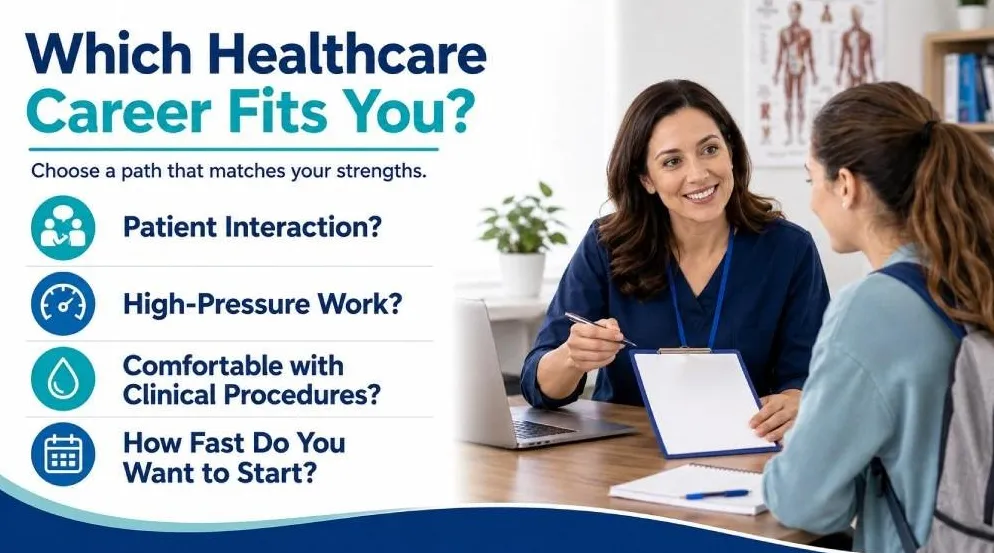
Do you want direct patient interaction?
If the answer is yes, careers such as medical assisting may be worth exploring.
If you prefer working behind the scenes, medical billing and coding may be more appealing.
How do you handle pressure?
Someone who enjoys fast-moving environments may be comfortable working in an operating room.
Someone who prefers predictable, detail-focused tasks might be happier in healthcare administration or coding.
Are you comfortable with blood and medical procedures?
This sounds obvious, but it is an important question.
A student may love the idea of healthcare but discover that a surgical or highly clinical environment is not the right fit.
How quickly do you want to enter the workforce?
Healthcare education pathways vary considerably.
Some professions require extensive degrees and licensing, while others can be entered through diploma, certificate, or associate-level training programs.
Understanding the educational timeline should be part of your career decision from the beginning.
Some of the Best Healthcare Opportunities Are Outside the Most Famous Careers
When high school graduates and career changers think about healthcare, they frequently focus on a small number of occupations.
But the healthcare system depends on hundreds of different professionals.
Many of the strongest opportunities exist in allied health — careers that support diagnosis, treatment, surgery, rehabilitation, patient care, and healthcare operations.
If you’re currently comparing career options, reviewing the fastest-growing healthcare fields can give you a clearer picture of where demand is developing and which healthcare paths may be worth considering.
Researching several careers before choosing a training program can prevent you from selecting a field based only on name recognition.
