

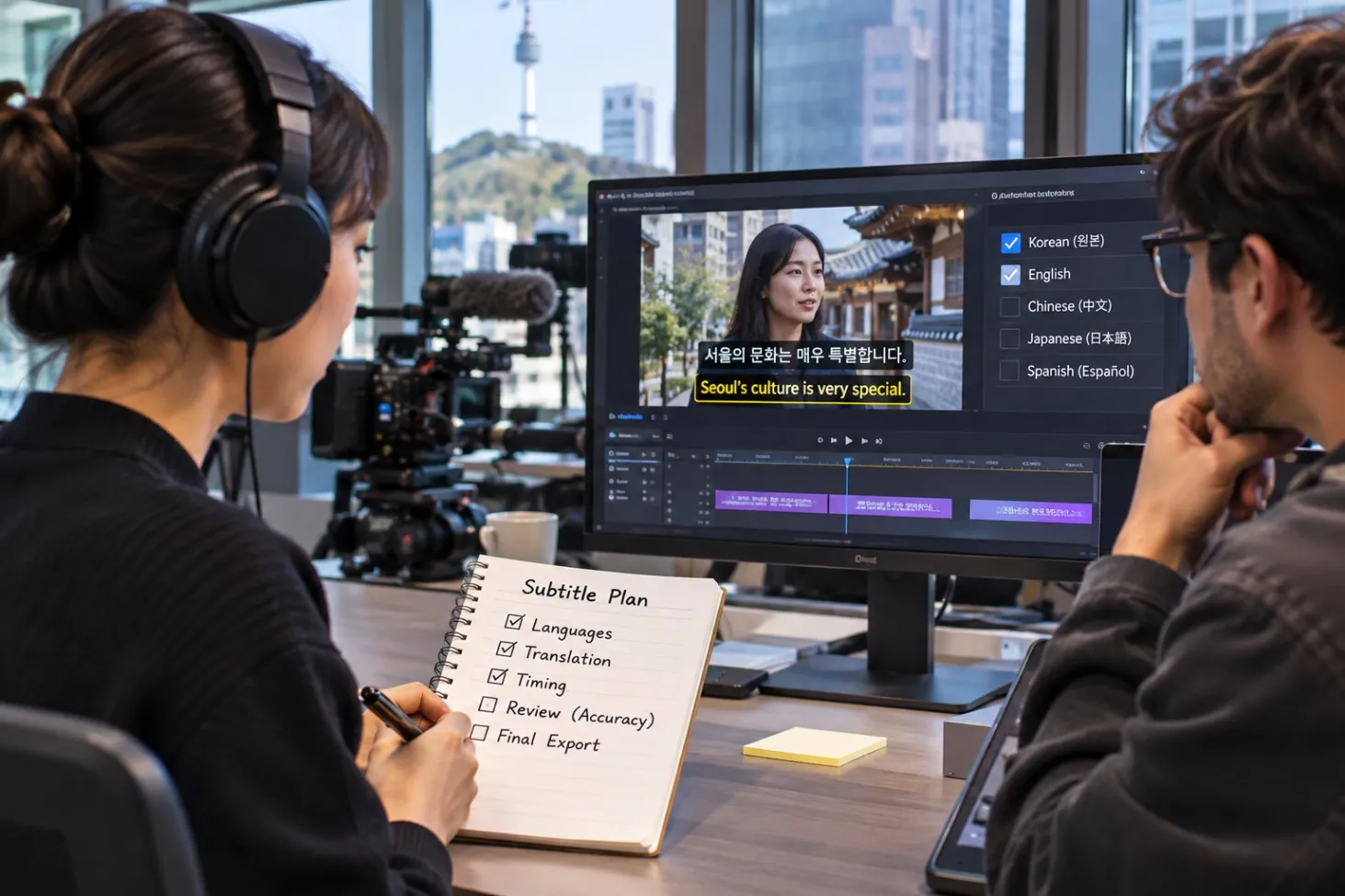
Subtitles are often discussed near the end of a video project, after the edit has settled and the deadlines are approaching. For multilingual productions, that is usually too late to make every decision comfortably. Interviews in Korean and English, specialist vocabulary, overlapping speakers, and cultural references can complicate translation. The production may also need different subtitle versions for broadcasters, websites, and social platforms. Planning language access early improves accuracy and can prevent the edit from becoming trapped by missing context.
Decide Who the Film Is Speaking To
A film made primarily for Korean viewers may explain a topic differently from a documentary intended for an international audience. Producers should identify the main audience, expected distribution formats, and languages needed before interviews begin. The answers influence questions, graphics, names on screen, and whether a speaker should be invited to explain unfamiliar terms.
This does not mean simplifying every cultural detail. It means providing enough context for the intended audience to understand what matters without distorting the speaker’s meaning. A careful translation process respects both the individual voice and the needs of viewers.
Brief Interpreters on the Editorial Purpose
An interpreter working beside a film crew needs more than an address and call time. Share the subject of the interview, a list of technical terms, and any sensitive topics in advance when appropriate. Explain whether interpretation will happen consecutively or in real time. The decision affects interview pacing, camera framing, and the amount of clean audio available afterward.
A documentary fixer South Korea may help coordinate local communication and identify practical language needs. However, producers should still arrange qualified language support for complex legal, scientific, or sensitive material. Familiarity with a city is not the same as expertise in every specialist field.
Keep Original Language Recordings Intact
Transcripts and translations are working documents, not substitutes for source recordings. Preserve the original audio, note speaker identities, and track the timecodes attached to translated passages. When a quote is shortened for pacing, editors must ensure that the resulting meaning remains fair. A fluent reviewer should check passages where wording could change the interpretation of an event.
It is also useful to mark uncertainties rather than silently resolving them. A proper noun, dialect expression, or unfinished sentence may need checking with the speaker or researcher. Honest notes are better than confident guesses that later appear as on-screen facts.
Think About Subtitle Space During Filming
Lower thirds, captions, and subtitles all compete for room on the screen. Frame interviews with enough visual space for readable text, especially when the project will be viewed on mobile devices. Fast cuts and dense information graphics can make accurate subtitles difficult to read. When the video includes signs or documents, viewers may need time to process translated on-screen text as well.
A Full Service Production Company in Korea can support coordinated planning across filming and postproduction tasks, including editing, subtitles, translation, and other finishing work. Producers should confirm which services are included in a specific project rather than assuming every language deliverable is automatic.
Plan for Review, Accessibility, and Delivery
Subtitle quality involves timing, consistency, readability, and factual accuracy. A reviewer should inspect the completed video, not only a spreadsheet of dialogue. Check names and titles against verified records, ensure lines stay on screen long enough to read, and listen for moments when speech and text no longer match. Additional captions may be needed to identify significant non-speech sounds for accessibility.
Different platforms may require burned-in subtitles or separate caption files. Establish those requirements before export so the final team does not have to rebuild files at the deadline. Clear version labels help avoid uploading the wrong language cut.
A useful production test is to show a subtitled sample to someone who understands the subject but has not seen the raw interview. Ask what they understood and where they became confused. This review can reveal missing context, unexplained abbreviations, or subtitles that disappear too quickly. It is much easier to correct these problems in a short sample than after all language versions have been exported. The feedback should guide readability, not rewrite the participant’s meaning.
Conclusion
Language access is part of storytelling rather than an administrative task after storytelling ends. When producers plan interpretation, transcription, subtitle space, editorial checks, and delivery formats from the start, multilingual films become more accurate and easier to watch. Thoughtful language decisions also protect contributors from being misunderstood. The best subtitles draw little attention to themselves because they let audiences follow the person and the story with confidence.
