

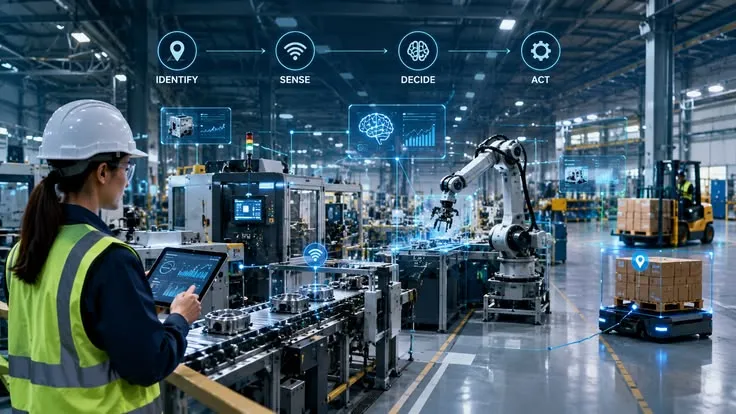
Smart factories represent a fundamental evolution in industrial production. By combining advanced robotics, artificial intelligence, sensors, connectivity and data analytics, these facilities move beyond traditional automation toward systems that sense conditions, make decisions and adapt in real time. The result is more flexible, efficient and resilient manufacturing capable of responding to changing demands and constraints.
From Fixed Automation to Intelligent Systems
Earlier generations of factory automation relied on programmed machines performing repetitive tasks with high precision but limited flexibility. Modern smart factories integrate robots with artificial intelligence so that equipment can interpret sensor data, predict outcomes and adjust operations. Manufacturing AI has progressed from primarily detecting defects or equipment anomalies to supporting production planning, optimizing machine settings and responding to changing conditions on the floor.
Digital twins—virtual replicas of physical processes and equipment—play a central role. These models allow manufacturers to simulate changes, test scenarios and refine operations before applying them in the real world. When paired with live data from the plant, digital twins help close the loop between insight and action.
The Expanding Role of Robotics
Industrial robots have long handled welding, painting, assembly and material handling. Today’s systems are becoming more capable and adaptable through AI integration. Collaborative robots, or cobots, work alongside human operators with built-in safety features, making automation accessible in mixed environments. Autonomous mobile robots support internal logistics by transporting materials and navigating dynamic spaces.
Physical AI—intelligence embodied in machines that interact with the physical world—is gaining momentum. Early pilots of humanoid robots in automotive and other manufacturing settings illustrate the direction of travel, though widespread deployment remains gradual. These systems aim to perform varied tasks in environments designed primarily for people, expanding the range of work that can be automated while still requiring human oversight.
Key Enabling Technologies
Several technologies underpin smart factories. Industrial Internet of Things sensors collect continuous data on machine health, process parameters and environmental conditions. Edge computing processes this information close to the source, enabling faster responses than systems that rely solely on centralized cloud analysis. Software-defined automation increases flexibility by allowing functions to be updated and scaled more readily than purely hardware-driven approaches.
Agentic AI systems can pursue defined goals—such as balancing throughput, quality, energy use and resource availability—while operating within safety and business constraints. These capabilities support more autonomous orchestration of production lines and supply activities.
Benefits for Industrial Production
Smart factories deliver measurable advantages. Higher levels of automation help address labor shortages and rising costs by handling repetitive or physically demanding tasks. Consistency improves quality and reduces variability. Real-time monitoring and predictive capabilities lower unplanned downtime through earlier detection of issues.
Flexibility is another major gain. High-mix, lower-volume production becomes more practical when systems can reconfigure more quickly. Data-driven optimization supports better resource use, including energy and materials, contributing to sustainability goals. Resilience increases as factories gain the ability to adapt to disruptions in supply, demand or equipment performance.
Human and Machine Collaboration
Contrary to purely “lights-out” visions, many advanced implementations emphasize collaboration between people and intelligent systems. Workers shift toward oversight, exception handling, maintenance of complex systems and higher-value decision-making. New skills related to data interpretation, system monitoring and human-machine interaction become increasingly important.
Training and workforce development form essential parts of successful transitions. Organizations that invest in preparing employees for these evolving roles tend to realize greater benefits from the technology.
Implementation Considerations
Moving toward smarter operations typically builds on existing automation rather than requiring complete replacement. Brownfield facilities can add connectivity, sensors and AI layers progressively. Clear goals, strong data foundations and attention to cybersecurity are critical, as increased connectivity expands potential risk surfaces.
Safety remains paramount. Integrated safety systems, defined operational boundaries for autonomous functions and mechanisms for human intervention help ensure that intelligence enhances rather than compromises protection.
Looking Ahead
The trajectory points toward higher degrees of autonomy and adaptability. Factories are expected to become more self-optimizing, with AI supporting continuous improvement across planning, execution and quality. Physical AI and more sophisticated robotics will expand the scope of tasks that machines can handle reliably. At the same time, the most effective operations will continue to combine technological capability with human judgment, creativity and accountability.
Smart factories and advanced robotics are reshaping industrial production by making it more responsive, efficient and capable of sustained competitiveness. Organizations that thoughtfully integrate these technologies—focusing on connectivity, intelligence, collaboration and continuous learning—position themselves to meet the demands of a rapidly evolving manufacturing landscape. The future of production lies not in machines alone, but in intelligent systems that amplify human potential while delivering greater precision, flexibility and resilience on the factory floor.
Read more – gloryhouseworld.com
