

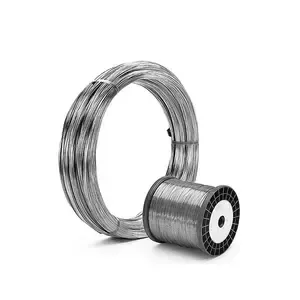
The growth of automation, robotics and precision engineering has raised the demand for materials that can provide more than traditional metals. The NiTi alloy Nitinol Wire is one of the materials being much talked about. Nitinol wire is often tested in research settings for use in actuator studies due to its ability to provide controlled motion while remaining strong and flexible. These properties are significant in the development and engineering of new actuator technologies.
Why Nitinol Is Suitable for Actuator Research
The function of an actuator is to convert energy into motion. While traditional actuator systems use motors, hydraulics or pneumatics, researchers are still researching other technologies that can be used to create a compact actuator with efficient movement.
The shape memory and superelastic properties of Nitinol wire make it useful. It is also found to be shape-recovery under suitable conditions after it is deformed, and thus suitable for experimental actuator designs that require controlled movement.
It is light too, which helps out a lot on builds where total mass really matters.
Supporting Innovation Across Research Fields
High-tech actuator study stretches far past just one firm. Smart materials are still being explored in the field of precision systems at universities and other laboratories as well as engineering organizations.
Typical research topics are:
-
Robotics
-
Aerospace engineering
-
Medical technology
-
Industrial automation
-
Laboratory prototypes
-
Precision instruments
In these fields, nitinol wire for actuator research provides opportunities to study motion control, compact mechanical systems, and innovative design approaches that may not be possible with conventional materials.
Material Properties That Benefit Development
The choice of advanced materials is made by the researchers according to the technical needs of an experiment or prototype. Nitinol has several properties that are favorable for actuator development.
Some of these are very good flexibility, corrosion resistance, fatigue resistance and repeatable mechanical behavior. In applications where compactness or low weight is a key consideration, Nitinol Wire also shows good performance.
These properties enable the engineer to explore new actuator concepts and to ensure that material performance is maintained during repeated testing.
Design Considerations for Research Projects
Each actuator project will have different performance requirements. Researchers will usually consider operating conditions, expected movement, loading requirements and environmental factors before making a material selection.
The performance of wire in an experimental system is influenced by the diameter of the wire, its transformation behavior, the operating temperature and the mechanical properties. The knowledge of these properties enables research groups to decide on the best-suited Nitinol Wire for their needs.
Early evaluation also minimizes the chances of redesign in the development process.
The Importance of Reliable Material Supply
Research projects typically involve several phases, such as testing in a laboratory, prototype development, and refinement of the product. It is crucial that the material be the same and that the process be the same throughout these stages to ensure consistent results and repeatability.
By collaborating with experienced suppliers, researchers can access technical documentation, manufacturing consistency and product options, which aid continuous development. The ability to get reliable material too is important when further testing or changes to design are needed to maintain continuity.
Good suppliers’ relationships help projects move through more smoothly, and research planning is more efficient.
Looking Beyond Current Applications
Researchers are finding new ways to use smart materials in advanced technologies as they become ever more popular. Nitinol Wire continues to be a critical material for the development of miniaturized actuator systems requiring controlled motion and reliable performance.
Further studies could broaden its application in the field of emerging technologies, aiding in the development of lighter, more efficient and increasingly complex mechanical systems. The material is flexible and can be used for both experiments and commercial use.
Conclusion
For companies and research groups in the field of actuator research, nitinol wire can be a promising material. To gain insight into this high-performance nickel-titanium material, regmetals.com offers valuable information for those organizations and research groups. Pick the right Nitinol Wire for your job needs. Good tech help builds better test models. This keeps build work smooth and clear. For top actuator jobs, talk to true metal pros.
