

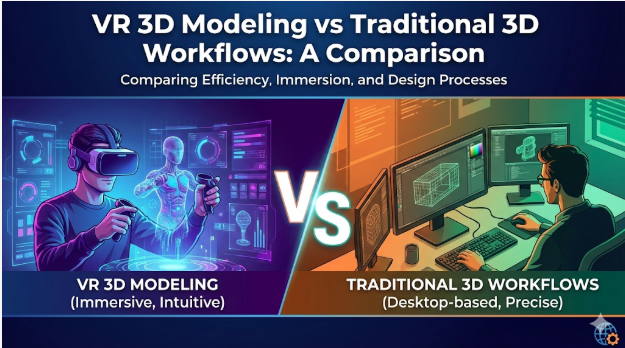
With the current development of digital design tools, architects, product designers, and engineers reconsider the way they develop and assess 3D models. We now have two prevailing formats of modern workflows: the traditional 3D modeling and VR 3D modeling. Although they both seek to create good and effective designs, the manner in which the designers deal with models is quite different.
Knowing the strengths and weaknesses of any of the approaches can assist teams in making the correct workflow, or rather a combination-choice based on their projects.
Understanding Traditional 3D Workflows
The classical 3D processes are based on software tools running on desktops where a designer operates a mouse, keyboard, and a two-dimensional display to design three-dimensional models. This is the traditional industry standard method of doing things and is still heavily used by professional 3D modeling services.
Conventional work processes are characterised by:
- Excellent accuracy and elaborate control.
- High level of compatibility with engineering and production tools.
- Documented and well-established pipelines.
Traditional 3D workflows are very effective in technical modeling, construction documentation, and end product production.
What Is VR 3D Modeling?
VR 3D modeling allows designers to design and view 3D models in an immersive VR environment. VR devices are used with motion controllers and VR headsets, and the user is able to enter the world of models and move around and interact with objects in reality.
Instead of perceiving a design on a screen, designers perceive it in space and can have an immediate understanding of proportions, depth, and relationships of items.
Key Differences in Design Interaction
The most basic distinction of these methods is the interaction of the designers with their models.
Conventional processes involve designers reading depth and scale visually; they have to interchange between numerous views to comprehend the spatial relationship. This technique is accurate yet may be abstract.
Conversely, VR 3D modeling allows a direct spatial interaction. Designers are able to enter the model and evaluate scale immediately, and decide according to the perception of reality. Such a rich experience can result in quicker learning and a more precise intention of design.
Spatial Understanding and Accuracy
In most projects, spatial accuracy is a crucial element. The conventional 3D processes use measurements, dimensions, and experience to make it accurate.
VR gives it one more dimension, as it allows designers to see spaces through the eyes of users. Using VR -3D modeling, it is easier to discover:
- Awkward proportions
- Clarity and the problem of accessibility.
- Difficulties of circulation and visibility.
VR is increasingly being used as a validation tool in many sophisticated processes of 3D modeling to add precision to conventional processes.
Collaboration and Client Communication
Another field where VR is superior is collaboration. Conventionally, it was a common practice to share screenshots, renders, or files, which may cause misunderstandings, particularly among non-technical stakeholders.
VR 3D modelling is the ability to build common immersive spaces where customers and teams can view designs collaboratively. This increases the communication, the speed of feedback, and the revisions involved.
Learning Curve and Accessibility
Conventional 3D tools are very steep to learn and are supported and taught in large numbers. These systems are already known to most design professionals.
VR modeling is a platform that brings new hardware and interaction solutions. It is intuitive when one learns it, but it should be an investment and training first. Nevertheless, with the increased convenience of VR tools, there is a growing adoption of the tool in professional 3D modeling services.
Cost and Workflow Efficiency
Conventional work processes usually demand conventional computing hardware and license rights. VR processes introduce the expense of headsets and other compatible systems.
As said, VR 3D modelling can enhance efficiency by:
- Reducing design errors
- Accelerating approvals
- Reducing late-life modifications.
These advantages supersede the setup expenditures in several projects.
When to Use Each Approach
Conventional 3D processes are suitable for:
- Implementation of sophisticated technical modelling.
- Production and design of products.
- Final production assets
VR modeling is more appropriate in:
- Concept development
- Spatial checks and reviews of designs.
- Client appearances and tours.
Practically, a significant number of 3D modeling services are a combination of both methods to take advantage of their strengths.
Conclusion
The classical working methods and the VR 3D modeling are both significant in a modern approach to building design. The conventional approaches are accurate, dependable, and technical in nature, whereas VR is immersive, spatial, and collaborative.
VR does not substitute workflow as it completes the process, making it more comprehensive and efficient. With further development of technology, the services of 3D modeling, which incorporate VR into the workspace, will be in a better position to provide correct, captivating, and futuristic design solutions.
